
("So, Mrs Jones, number four is the man you say pulled your husband from his surfboard and bit his leg off above the knee?"
"*sniff* Yes, Officer... I'd know that face anywhere... *sniff*")


 Note that the data points that are from Paper 2 are exactly the same, but the data points that are not actually shown in Paper 2 (and are presumably from Paper 1) have wobbled around quite a bit. Paper 3 doesn't say so, but it is possible that all the points in these two plots that aren't the published points from Paper 2 come from the data used in Paper 2 but not shown (and hence for the no-oil curve, the same as Paper 1) Note that the positions of the open circles in the open circles in the z0 graph are actually quite different between Paper 1 and Paper 3, which suggests to me that the author of Paper 3 got hold of the raw U(z) plots for Paper 1 and re-fit them to the first equation we thought of.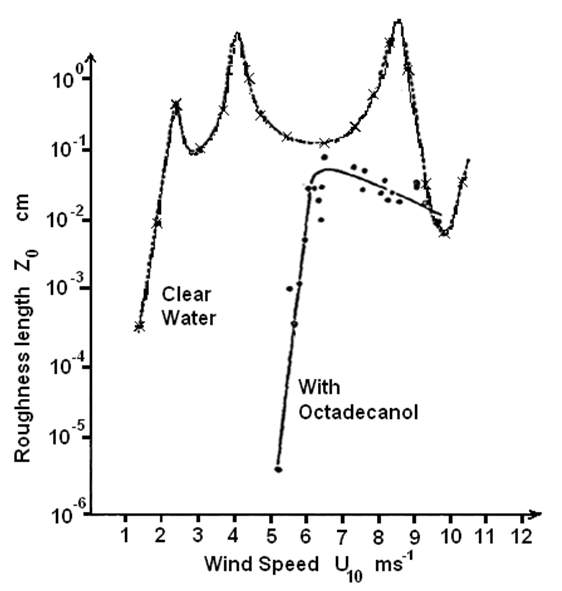


 ***: Actually, I didn't take it back to the library, I lost it on my own bookshelves! Here is the quote: Not a word here is said of acausality, wave mechanics, indeterminacy relations, complementarity, an expanding universe, continuous creation, etc. ... On this I can cheerfully justify myself: because I do not think that these things have as much connection as is currently supposed with a philosophical view of the world. ... In 1918, when I was thirty-one, I had good reason to expect a chair of theoretical physics at Czernowitz ... I was prepared to do a good job lecturing on theoretical physics ... but for the rest, to devote myself to philosophy, being deeply imbued at the time with the writings of Spinoza, Schopenhauer, Mach, Richard Semon and Richard Avenarius.
Getting nitrogen from Titan won’t stand up to any sort of cost-benefit analysis.
There are unlikely to be enough noble gases trapped deep underground from radioactive decay to amount to a hill of beans.
Thus, it has been suggested that molecular nitrogen could be obtained by ‘burning nitrates’, which seem to be present (or may be present) in considerable amounts in the Martian crust.
However, simply heating nitrates will not be very effective as a way to ‘dilute’ oxygen. For instance:
2Na(NO3)2 + heat → 2NaNO2 + O2
2NaNO2 + more heat → Na2O + NO + NO2
2Ca(NO3)2 + heat → 2CaO + O2 + 4NO2
Thus ‘burning’ nitrates generates lots of toxic gas, and some extra oxygen.
Of course, with more energy input:
2NO2 + much more heat → N2 + 2O2
So we have got some nitrogen eventually, but at a cost of 2.5 oxygen molecules per nitrogen molecule.
If we don’t want to add lots of extra oxygen to the atmosphere, we will have to add a reducing agent instead, and do something more like ‘burning’ . On Earth, if we had lots of extra nitrogen dioxide we wanted to get rid of, we would do something like:
NO2 + 2H2 → N2 + 2H2O
Or
NO2 + C → N2 + CO2
Or more realistically, something like
4NO2 + C3H8 → 3CO2 + 4H2O + 2N2
The problem is that there is not a lot of carbon or hydrogen on Mars that is not already incorporated in carbon dioxide or water. I haven’t googled to find out how much hydrogen has been located/postulated on Mars, but a crude atom balance suggests that if we want to burn nitrates with enough hydrogen to generate one nitrogen atmosphere, we need to burn at least two whole hydrogen atmospheres. I don’t think this is available, it would surely have outgassed long ago. I have found references to methane clathrates on Mars, which may be there in similar amounts to the nitrates (perhaps) and would allow the reaction
2NO2 + CH4 → CO2 + 2H2O + N2
The problem here is that it would be a very significant bit of geo-engineering to mine the methane and get it to the nitrates, or vice versa, and we are adding to the carbon dioxide load that we need to get rid of later.
So what other reducing agents are available? I suggest that much more cost-effective than bringing nitrogen from Titan would be to bring down some Iron-Nickel asteroids and rust them in nitrogen dioxide. The mass that would be transported would be much larger, but the distance would be much shorter, and there would be no need to do any complicated collection and packaging and transport, just provide the right nudge of energy to send the asteroid on a collision course with Mars.
The following reaction is certainly thermodynamically favourable, though I don’t have an idea of what its activation energy might be:
6NO2 + 8Fe → 3N2 + 4Fe2O3
While this uses considerably more mass of reductant to produce the same amount of nitrogen than methane would, instead of having to be painstakingly mined and collected like the methane, the asteroids could be crashed down into the nitrate deposits in one foul swoop. The reaction does not produce any extra carbon dioxide that will need to be scrubbed out later.
