Monday, September 26, 2011

Book Report, Part Two

There is a tide in the affairs of men,
Which, taken any way you please, is bad,
And strands them in forsaken guts and creeks
No decent soul would think of visiting.
You cannot stop the tide; but now and then,
You may arrest some rash adventurer
Who--h'm--will hardly thank you for your pains.

Vibart's Moralities, Rudyard Kipling


Further observations on the third strand: The author as curmudgeon

I had a few nit-picky observations on the third strand in the book, the generalised grumping about how everything has gone to pieces, but have decided to leave them behind and talk instead about the appearances of science in Bloom's book.


First they came for the philosophers...

Near the end of the book Bloom takes a tour of various disciplines, examining how they have fared in the twenty-odd years of the collapse of the idea of the university and to what extent they brought the calamity upon themselves. The hard sciences are the only ones that come out looking reasonable. They have not participated in the philosophical and political hijinks that have precipitated the crisis; their standards are maintained; their enrolments are solid; they are thought to be necessary: “Modern regimes were conceived by reason and depend on the reasonableness of their members. And those regimes required the reason of natural science in every aspect of their activity, and the requirements of scientific advance largely determine their policy.” Furthermore, the hard scientists are still essentially in touch with the 'philosophic use of reason' in a way that the rest of academia has largely abandoned. “The demonstrations of science come from within man, and they are the same for all men. When I think the Pythagorean theorem, I know what is in me at that moment is precisely the same as what is within anyone else who is thinking that theorem. Every other supposedly common experience is at best ambiguous.” From the vantage point of now, it looks like a perfectly splendid time to be a scientist. I can see why Bloom is at times a bit irritable with them.

Bloom sees the main flaw of the hard scientists within the university as rejection of community: collectively they are happy to hover Laputa-like over the chaos below; individually they are happy to pursue interests so narrow as to be 'immoral nonsense' to practical men, and do not lift their eyes to see the necessity of a philosophy to unify what they do. Both these criticisms are more or less true. On page 351 he says: 'inwardly they believe that the only real knowledge is scientific knowledge'. So we do. So the desire to ignore all the tomfoolery going on around us is strong. And most of us are very narrowly focussed. We are aristocratic in Bloom's sense in that we believe details are important, and that progress is not often made through generalisations. When we venture into the wider world even the greatest of us are apt to write things that are shallow and silly.

Yet in defence: science is the radical democratic form of knowledge. There is room for all on the floating island. Join us. And, while most of us might not lift our eyes to make sense of what we do within a coherent philosophical view of the world, Bloom does not offer any philosophy worthy of our attention. Neither does he pay any attention to the great philosophy that was in fact created by a working scientist: pragmatism is not mentioned until p.378, only a few pages before the conclusion, and Peirce not at all.

And the last 29 years have not been kind to us. The natural sciences are no longer a 'Gibraltar' standing aloof from the relativism of the wider institution. The graduates of '82 are the movers and shakers now, the people at the top of their careers, and we live in the world they have made. The graduates of '82 were brought up under the shadow of nuclear war, with Rachel Carson's “Silent Spring”, and Three Mile Island, and they do not much like us. Seen only as a commodity for maintenance of a technological society, we are in oversupply in the developed world. It is easier to outsource our function to other lands. On this utilitarian basis science has been hollowed out across Australia: a scary number of Australian 'universities' have ceased to offer an internationally recognisable physics or chemistry major. In the country Bloom was writing about, science no longer commands the respect it once did. It is not exciting. There is no money in it. There are the best science departments in the world, and the native-born, still filled with Tocqueville's democratic spirit after all these years, stay away from them.

Saturday, September 17, 2011

Book Report, Part One

Through the trick of taking a lazy holiday I have made it to the end of Allan Bloom's “The Closing of the American Mind”, which my father sent me. I found it difficult going. It is a book that reads as if it was translated from the French – it has the opacity, the peculiar internal structure, and the sort of elliptical, rhetorical, arguments that abound in the few books translated from the French on philosophical matters that I have read and forgotten the titles of.

I am sure Bloom structured the book the way he did for some purpose. But to me the structure did not help. To my reading there are approximately three separate strands in the book, which I will go through in order of importance.

The first strand is the description, not of how higher education has failed democracy, but rather how democracy has failed higher education: how the democratic habits of mind described by de Tocqueville as corrosive to the idea of a university have proved, in fact, to be corrosive of the classical idea of a university. The hyperindividualism, the utilitarian view of knowledge as a means to profit, the disregard for the past: these are just American traits, not unique to American university students of the late 20th century. They are all traits observed and explained by de Tocqueville in the 1830s as consequences of democracy and of the peculiarities of the American circumstance.

Bloom asserts that a university ought to act as a counterbalance to the particular tendencies of thought encouraged by a democratic society. This is a perfectly reasonable assertion, and the problem then becomes the internal motivation for the members of universities to keep swimming against the current, so to speak. “To sum up, there is one simple rule for the university's activity: it need not concern itself with providing its students with experiences that are available in democratic society. They will have them in any event. … The universities never performed this function very well. Now they have practically ceased trying.” (p.256)

Why did universities perform this function badly? Why have they ceased trying? The explanation suggested by Bloom for them ceasing to try is the adoption of bad German philosophy, and an extensive discussion of the intellectual genealogy of this philosophy forms the second strand of the book. I found this part difficult to follow as an argument, though it is clear as a history of thought. Bloom traces the modern university to the Enlightenment, as an effort to bring philosophy to bear in the shaping of society, instead of remaining a separate thing. Of this enterprise he says: “It was not by forgetting about the evil in man that they hoped to better his lot but by giving way to it rather than opposing it, by lowering standards” (p.296).

Bloom is never clear about which thinkers he agrees with and which he disagrees with, so the extended history lesson serves mainly to show – to me, at least - that the ideal of the modern university is poisoned at the root. To my mind Bloom vindicates the American tendency to ignore the past and makes a very good case for ignoring Rousseau, Hobbes, Locke, Kant, Nietzsche, etc., as wreckers and blind guides. The fundamental assumption of political philosophy held by these thinkers – that man is by nature a solitary being - is rubbish. I think Bloom sees this, but he does not state it until much later in the book, and then obliquely: “Reading Aristotle helps to lay bare the hidden premise underlying modern social science, that man is by nature a solitary being, and could provide the basis for making a debate of it again.” (p. 366)

The culmination of the strand of philosophy which Bloom traces is Weber, in the early twentieth century, who says that old-style Enlightenment rationalism is dead. “All future discussion or study must proceed with the certainty that the perspective was a 'naïve' failure. Reason cannot establish values, and its belief that it can is the stupidest and most pernicious illusion.”[1] Thus the university, seen as an Enlightenment project, cut off its own legs. There are very conflicted and contradictory signals about the value of the Enlightenment and post-Enlightenment philosophers in Bloom's book. Like Simone Weil, but by demonstration rather than explicit argument, he seems to be saying that its all there in Plato and that all the philosophising done between us and Ancient Greece is bosh. I am not sure if that is what he means to say, but that is what he seems to be saying.

The third strand in the book is essentially cranky reactionary old man. He complains about the sexual revolution and the intellectually deadening effects of the kind of music young people listen to nowadays. To a large extent I find this congenial, but it isn't convincingly tied to the rest of what he says to make a coherent argument for how and why society has gone wrong and what the university can do about it. It is just grumbling garnished with learned quotations.

All in all 'The Closing of the American Mind' is not a very good advertisement for an open American mind. It lacks clarity, it lacks structure, it lacks a sense of proportion, and it lacks a positive program. The book is a good illustration of my (thoroughly unoriginal) analogy that religion and science are the two eyes of humanity: if you only have one, you will have a two-dimensional picture of the universe. If you don't have either, you will stumble around blindly running into things. To my mind the great enemy, the cause of the evils that have cast down the university, is relativism. To fight relativism you need to assert an absolute. And you need to do this with authority, not like the scribes and Pharisees.

Further observations on the first strand: How Democracy Has Failed Higher Education
It is all there in de Tocqueville's “Democracy in America” As Tocqueville says: “I think that in no country in the civilized world is less attention paid to philosophy than in the United States.”
The way organisation of society on democratic principles leads its members to distrust elitism in all its forms works against higher education, traditionally understood, making a significant impact. De Tocqueville again: “The nearer the citizens are drawn to the common level of an equal and similar condition, the less prone does each man become to place implicit faith in a certain man or a certain class of men. But his readiness to believe the multitude increases, and opinion is more than ever mistress of the world.”

And for a third time, here is one more long quotation from de Tocqueville: “Permanent inequality of conditions leads men to confine themselves to the arrogant and sterile research of abstract truths; whilst the social condition and the institutions of democracy prepare them to seek the immediate and useful practical results of the sciences. … Men living in democratic ages cannot fail to improve the industrial part of science; and that henceforward all the efforts of the constituted authorities ought to be directed to support the highest branches of learning, and to foster the nobler passion for science itself. In the present age the human mind must be coerced into theoretical studies; it runs of its own accord to practical applications; and, instead of perpetually referring it to the minute examination of secondary effects, it is well to divert it from them sometimes, in order to raise it up to the contemplation of primary causes.”

How can people who are themselves part of a society distance from themselves sufficiently in order to coerce it in an unnatural direction? Only if they are consumed with a fiery ideal. Since they are now divided, confused, and themselves steeped in the practical, egalitarian principles of democratic culture, it is quite beyond their capacity.

Bloom points out that in 1930 the American universities could have disappeared from the face of the Earth without any great impact on human intellectual activity, and that the dominance of American universities in the post-War period is due to the influx of refugee intellectuals from Europe. Thus, it seems to me that the failures he notes are due largely to the retirement of this generation, the reassertion of historical inevitability, and the failure of the exotic transplant to flourish on the infertile soil of the New World.
I think de Tocqueville's observations about the effect of democracy on higher learning are correct, and the decay of the university on American soil to a large degree historically inevitable. I do not see a remedy.[2]

To see how perniciously the anti-elitism encouraged by democracy, and the 'practical applications' (i.e., profitability as the sole criterion of value) encouraged by democracy, dominate Australian higher education today, I recommend perusal of the blog 'The Common Room' at the Australian newspaper. See here, for instance.

There is no discussion about the role of a university any more. We exist to perpetuate our own existence by doing things that are profitable. That is about it. Bloom's graduates of '82 are now the movers and shakers of the system, the people in the prime of their careers, and his conclusion is even more true today: “It is difficult to imagine that there is either the wherewithal or the energy within the university to constitute or reconstitute the idea of an educated human being and establish a liberal education again.”


Further observations on the second strand: Philosophical trends in higher education since the Enlightenment
I have been reading a lot of Chesterton so I will be essentially parrotting him here, but an analysis of the Western university that begins with the Enlightenment begins halfway through the story. There is no acknowledgment that the modern university grew out of an older institution that had a defined role in Western civilisation and went along fulfilling it without existential crisis for more than half a millennium. There are few and slighting references to Aquinas in this book, but at the end Bloom admits that Catholic universities will be one of the few places study of philosophy will cling to existence, thanks to the Scholastic connection with Aristotle. Higher education is not after all poisoned at the roots, but poisoned halfway up the trunk, by the Enlightenment. When Bloom says “because there is no tradition and men need guidance, general theories that are produced in a day and not properly grounded in experience, but seem to explain things and are useful crutches for finding one's way in a complicated world, have currency” (p. 254), whether he intends to or not, he is referring to all the theories of the Enlightenment.

The classical university of the Middle Ages recognised Man as a social animal: as a creature that is born into a society and cannot exist alone. The most 'primitive' tribe is a complicated net of social obligations, and this net of obligations is the main adaptation for survival of our species. Any theory based on the idea that 'man is by nature a solitary being' will fail. This agreed-upon net of social obligations also entangled the members of the university in its original conception. Without it, the cohesiveness of the university disappears and it becomes unable to resist the society in which it is embedded. A small group of zealots can perhaps maintain a cohesiveness based on shared principles other than those that animate it society: but as the university expands, this will inevitably be lost.

Bloom explains the failure of universities to hold their nerve to the corrupting influences of a philosophy that ended up by devaluing reason, the philosophy of Nietzsche and Weber. But I think this can only be of minor importance. As Bloom has outlined in the first strand of the book, the nature of democratic society is inherently hostile to the traditional university project.

In the later 20th century, as the university expanded towards mass participation, whatever capacity it had to resist the pressures of the society was diluted. The two things are strongly coupled: so long as participation inexorably increases, so will the fact of the university diverge from the idea of the university.

[1] Bloom says that 'We hold these truths to be self-evident' is an example of reason establishing values. Maybe that is how the framers understood it. But a truth that is 'self-evident' is by definition not established by reason! The muddy argument in this book is a far cry from the clarity of Chesterton: “The fault of the great mass of logicians is not that they bring out a false result, or, in other words, are not logicians at all. Their fault is that by an inevitable psychological habit they tend to forget that there are two parts of a logical process – the first the choosing of an assumption, and the second the arguing upon it; and humanity, if it devotes itself too persistently to the study of sound reasoning, has a certain tendency to lose the faculty of sound assumption. It is astonishing how constantly one may hear from rational and even rationalistic persons a phrase such as 'He did not prove the very thing with which he started' or 'The whole of his case rested upon a pure assumption,' two peculiarities which may be found by the curious in the works of Euclid.” (From the essay on Carlyle in 'Twelve Types')

[2] Democracy is not the only social structure that discourages the university. The centralised authoritarian state also discourages it as any more than a training place for practical pursuits: it does not matter whether we are all equal under God or under the party. I am afraid that Bloom's assertion “There is no intellectual ground remaining for any regime other than democracy” (p. 330) has turned out to be overly triumphalist. In the past twenty years I have seen the universities of the PRC go from a joke to the arbiters of quality to the rest of us, through the Jiao Tong ratings!

Friday, August 5, 2011

Us and Them

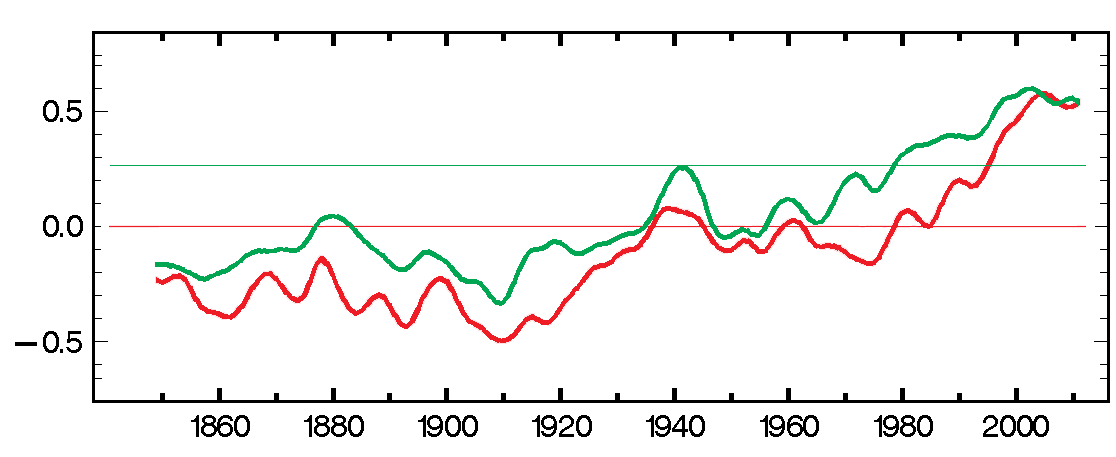
Any model for global warming has to explain the following figures, which show significantly more warming in the northern hemisphere than the southern hemisphere:

 (Bottom figure from http://nsidc.org/sotc/sea_ice.html)

One obvious difference between the northern hemisphere and the southern hemisphere is that there is a much larger fraction of ocean in the southern hemisphere than the northern hemisphere, and the ocean surely acts to moderate the air temperature. Whatever mechanism is heating the atmosphere, this heat may be being transferred to the ocean at an appreciable rate, despite the very slow mixing between surface water and deep water. 

Let’s do a rough estimation of this thermal buffering capacity using Google and our mad arithmetic skillz. If we suddenly spiked the temperature of the atmosphere by 10 degrees, how much would this increase the temperature of the deep ocean, assuming all that heat was transferred across?

8.50 km = height of atmosphere if it were all at 1 atm pressure
3.80 km = average depth of ocean

So volume of atmosphere : volume of ocean (assuming ocean covers 70% of Earth)
8.50 : 2.66

90% of the volume of the ocean is below the thermocline and will have at temperature between 0 and 3, saith the interwebz. Let’s assume at equilibrium we have just heated up this cold water, and the air and surface water have returned to the same temperatures they are at now.

So volume of hot atmosphere : volume of cold ocean
8.50 : 2.40

Volumetric heat capacity of dry air: 1.3 J.K-1.dm-3
Volumetric heat capacity of water: 4180 J.K-1.dm-3


So if the heat change in the air is
10 K x 8.50 V x 1.3 J.K-1.dm-3 = 110.5 J.V.dm-3

Then the ocean will increase by a temperature T, where
T K x 2.40 V x 4180 J.K-1.dm-3 = 110.5 J.V.dm-3

T = 110.5/(10042) K

My mad mental arithmetic skillz have deserted me, but instead of opening another window and doing it in Excel I will round it off to 100/10,000 K – near enough to 0.01 degrees. So the net effect of whatever cockamamie stuff we have done to increase the temperature of the atmosphere ten degrees has been to increase the temperature of the deep ocean from 1.5±1.5 C to 1.51±1.5 C.

Just something to think about.

But, maybe the difference between hemispheres is not due to the effectiveness of heat transfer to this ubersink. Since there is another obvious difference between the hemispheres. About 90% of the human population – and all that other stuff associated with humans – is in the northern hemisphere.
Most of the things we do to the atmosphere change what is going on near the surface, where there are big fluxes for all sorts of other reasons.  But we have made big changes to parts of the atmosphere where not much usually happens. Pumping carbon dioxide and water vapour into the upper atmosphere with our big jet planes, f’rinstance.


I’ve stolen this picture of a place in the northern hemisphere where there is a lot of air traffic. It often looks like this, though not quite as bad, where I live, which is a relatively air-traffic-crowded part of the southern hemisphere. The picture is at sunset because, while I don’t know much about clouds at all, it is obvious from standing around under them that they have a cooling effect during the day and a warming effect at night. And the Cloudspotter’s Guide by Gavin Pretor-Pinney, which I can recommend without reservation, assures me that the warming effect wins.

Just another thing to think about.

****

September 13th:

Of course, if you pick a different zero point, the two curves don't look all that different:

So probably there is nothing in it after all.

****
September 10th, 2013:

The sea-ice graph looks even better now, a few years on:

Sunday, May 29, 2011

It's a small world after all

My uncle Chuck has already hand-tooled instruments that have ended up in orbit around Titan. Now, he is at the forefront of mankind's asteroid-molesting efforts!

Wednesday, October 13, 2010

ZOMG CHEM 400

A little while ago I put together a presentation which gathers/scatters some of my thoughts on teaching chemistry in the 21st century for a learning and teaching symposium, which my colleague Dr Erica Smith very kindly presented for me while I was on long-service leave.

If you are at all interested, you can go here for a link to the first draft.

Erica tells me it went very well, though there was an interruption from the audience when I referred to non-scientists as 'muggles'; one gentleman apparently took exception to being called a muggle. Though I still think this is a perfectly valid characterisation - scientists are (1) the people who understand what is really going on, and (2) those who have the power to influence their environment in a meaningful way - I have removed it in the second draft. Muggles cannot help being muggles, after all, whereas it is open to everyone to learn to think in a scientific way.

***

September 16th 2011:

I thought I would just add the slide for the Conclusion in the powerpoint presentation of this and the accompanying text I sent to Erica...


"Chris put this line of untranslated Greek in on purpose and not (just) to show off.
Until recently, this was part of the common body of knowledge expected of an educated person in our civilisation: educated people would know a little bit of Greek and recognise this as a saying of the philosopher Heraclitus.


Now, anyone who sees it, whether they are educated or not, can look it up on Wikipedia. Chris doesn’t have to tell you what it means. It is pathetically easy for you to look it up so if you have the will to know you can go and do it.


(NB: If anyone asks about the years 1900-2000, you can make derisory comments about the ‘Age of Stupid’ … that was what I was going to do.)"

Sunday, June 27, 2010

Image Results for Chris Fellows

Of the Chris Fellowses in the world, the one with the largest web footprint is possibly the South African wildlife photographer known for his action shots of great white sharks. So if you google me you are likely to get results like this:


("So, Mrs Jones, number four is the man you say pulled your husband from his surfboard and bit his leg off above the knee?"
"*sniff* Yes, Officer... I'd know that face anywhere... *sniff*")

Best. Exam. Ever.


This is a reproduction in its entirety of my favourite exam of all time. It was for one of three coursework units we had to do in the Honours year and Dr Ken Adam had given me three books to read at the beginning of the year- one on Ab Initio Self-Consistent-Field Theory, one on Semi-Empirical SCF methods, and one on the application of computers to chemistry in general, with instructions to read them, except for one chapter in the last one. (Of course that chapter was about spectroscopy of molecules in interstellar space which was wildly exciting so I read it anyway).

Thursday, May 27, 2010

In praise of Control+C

Paper 1: Important for the transfer of energy and matter across the ocean/sea air interface are some parameters called the roughness length, z0, and the friction velocity, U*, of the interface that can be determined by measuring the velocity of the sea air at various heights above the water and fitting an equation, like so:


In 1969 a group of scientists from the Massachusetts Institute of Technology went out and did a bunch of measurements like this. They looked at the variation in z0 and U* as functions of U10, the air speed 10 m above the ocean surface. They took 299 separate wind speed profiles, binned by U10 like so:


From which they got the following graph for U* vs U10 :


And the following graph for z0 vs U10:


Now, the values in Fig. 3 and Fig. 2 come from the slope and intercept, respectively, of equation (1) fitted to the same data. So I don't know why they didn't put error bars on this second graph or why they drew such a wacky line through the data points, since they didn't have Excel with 'draw a stupid non-physical line through the points' as a default option.

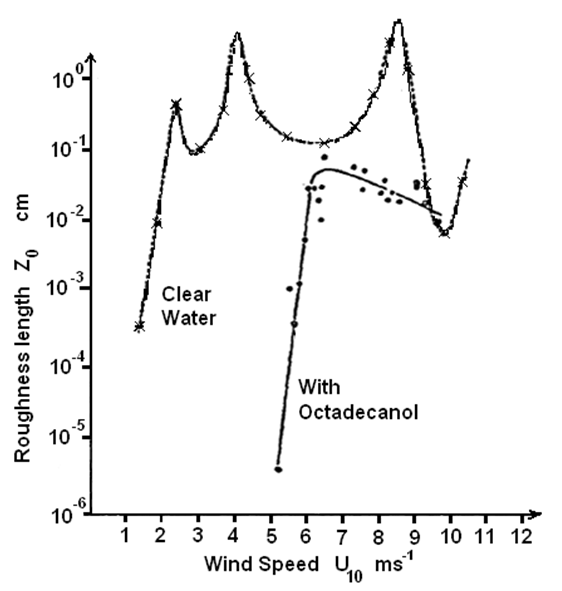
Paper 2: When they were sailing near Block Island this same group of scientists also did some more experiments where they poured oil on troubled water and took the same measurements, which they reported in another paper. This paper only has a graph for z0 vs U10:

And here they have only shown the trend line for the non-oil data because this paper was concentrating on explaining the oil data. They explained the difference between the oil data and the non-oil data using one model and not long afterward another scientist put out a paper (in Science, so no slouch of a paper) giving a different explanation for the difference.

Paper 3 (Science): The data presented in this paper (and cited as coming from Paper 2) looked like this:

Note that the data points that are from Paper 2 are exactly the same, but the data points that are not actually shown in Paper 2 (and are presumably from Paper 1) have wobbled around quite a bit. Paper 3 doesn't say so, but it is possible that all the points in these two plots that aren't the published points from Paper 2 come from the data used in Paper 2 but not shown (and hence for the no-oil curve, the same as Paper 1) Note that the positions of the open circles in the open circles in the z0 graph are actually quite different between Paper 1 and Paper 3, which suggests to me that the author of Paper 3 got hold of the raw U(z) plots for Paper 1 and re-fit them to the first equation we thought of.

Paper 4: Now for the fun part. This is from a much more recent review paper.

Exhibit 1:
This is cited as being 'after Paper 1 and Paper 2'. Sure enough, it is the data from Paper 2. But it isn't the data from Paper 1. It's the silly fitted line shown in Paper 2 with spurious data points added in crayon! How lame is that?

Exhibit 2:

This is reported as being 'data collected by [author of Paper 3] (after Paper 3)', as if it is a totally independent experiment!

...


This sort of thing could have been avoided if people in earlier decades had the ability to scan papers they were interested in and cut and paste bits of screenshots of them, like I've been doing.

FWIW this is what I reckon the curves should look like, drawn on the figures sourced from Paper 3 as they appear in Paper 4 - suspect points flagged from having big error bars and lying way off the U* trend-line as reported in Paper 1:

Sunday, May 16, 2010

"Any unauthorised use is strictly prohibited"

Here is a totally unauthorised reproduction of a seminar notice from the University of Sydney. It seems to describe a philosophical goal devoutly to be wished, with which I am in complete agreement:


SCHOOL OF PHYSICS COLLOQUIUM


Monday 17th May, 2010 at 3:15 pm

refreshments from 3pm

Venue: Slade Lecture Theatre, School of Physics

Title: Quantum foundations research @ Sydney

Presenter: A/Prof. Stephen Bartlett
University of Sydney

Abstract:

Despite a century of development since Einstein's explanation of the photoelectric effect, the foundations of quantum physics remain mysterious and surprising. Rather than accept the strangeness of quantum physics as a necessary evil, the research group in Quantum Foundations here at the University of Sydney is attempting to uncover the meaning and interpretation of the mathematical structure of quantum physics in terms of understandable concepts based on an external reality.

In this talk, I'll provide an introduction and overview of the Quantum Foundations research group here at Sydney, which includes researchers in Physics, Philosophy and HPS as well as a large-scale collaboration - the Perimeter Institute-Australia Foundations (PIAF) project.


The email concluded: "This email plus any attachments to it are confidential. Any unauthorised use is strictly prohibited."

So come and get me, seminar programme Nazis. :(

Friday, November 13, 2009

Red Mars, p.211

On re-reading Red Mars after more than a decade, I have been struck with how strongly 'red' my sympathies are. I don't remember feeling strongly one way or another when I first read the book. Now the prevailing mood among the first hundred Martians to begin terraforming immediately seems appallingly reckless to me, and I find myself in complete agreement with Ann Claiborne:

'Here you sit in your little holes running your little experiments, making things like kids with a chemistry set in the basement, while the whole time an entire world sits outside your door. A world where the landforms are a hundred times larger than their equivalents on Earth, and a thousand times older, with evidence concerning the beginning of the solar system scattered all over, as well as the whole history of the planet, scarcely changed in the last billion years. And you're going to wreck it all. And without ever honestly admitting what you're doing, either. Because we could live here and study the planet without changing it - we could do that with very little harm or even inconvenience to ourselves. All this talk of radiation is bullshit and you know it. There's simply not a high enough level to justify this mass alteration of the environment. You want to do that because you think you can. You want to try it out and see- as if this were some big sandbox for you to build castles in. A big Mars jar! You find your justifications where you can, but it's bad faith, and its not science.'


On page 173, the explorers find it 'startling in the extreme' to run across the tongue of a glacier, looking like a big white Uluru, even though they knew it would be there. I'm afraid they won't find anything startling, because they will have Google Mars.


Dunes in the Vastitas Borealis - let's not drown them just yet!


Of course, there isn't nearly enough water to do so- only 820,000 km3 or so.


Some changes we've made to the surface of Mars already- rover tracks on the edge of Victoria Crater:

Thursday, November 12, 2009

Happy Happy Joy Joy

Just thought I should say something about Peter Garrett blocking the Traveston Dam. This is a good, good, good, good thing. The Australian Lungfish is a species of global importance that we have a duty to look after. We make do at my place with the water that falls on our house and shed, and all those people in Southeast Queensland ought to do the same. Plants that won't thrive on rainwater have no place in Australian gardens.

Anyway, if Queenslanders want to be profligate, we have plenty of perfectly fine rivers in Northern New South Wales that we could dam to collect water to sell them...

Monday, November 9, 2009

Glass half full...

The system for electronic submission and return of assignments that came in this year is beset with all the usual follies and aggravations of new technology, but I have just made a jpeg to use in marking assignments that I am looking forward to using:


Friday, November 6, 2009

On trying to read Schopenhauer

Earlier this year Klaus Rohde made a number of posts about the ideas of Schopenhauer, the famous philosopher. I read one of the essays Klaus recommended on Schopenhauer’s thought and wrote a response to it.

I also read a book of extracts from Schopenhauer's ‘Parerga and Paralipomena’ in English and wrote two documents outlining some of the places where I agreed with what Schopenhauer said in the extracts, and some of the places where I disagreed with him.

But Schopenhauer wrote a magnum opus- practically the archetype of the magnum opus- outlining his mature thought, ‘The World as Will and Appearance’, which takes up three volumes in our library, and to argue about what he thought without reading it is really very lazy. So I thought I would have a go. I got out volume one, skipped the preface, and started wading in.

Unfortunately I did not get very far. And oddly enough I got hung up at the same point that a friend of mine got hung up on at the onset of ‘Mere Christianity’, by C. S. Lewis, when I lent it to him as an undergraduate. I rejected Schopenhauer’s initial argument, the foundation of the whole three volumes. The ‘oddly enough’ is because it was the identical initial argument of ‘Mere Christianity’- the assertion that consciousness is inexplicable by materialism. Lewis argues that consciousness is an irruption of the supernatural other into the natural universe, and from that goes on the derive Christianity; Schopenhauer argues that consciousness is the fundamental fact of the universe, the ultimate reality that generates the world of appearances around us, and that data from that world of appearances cannot explain consciousness.

I reject solipsism- the argument that the only data point I have is my own consciousness, therefore only I exist- because it is fruitless; you can’t do anything with it. It is an idea that leads nowhere and achieves nothing.

The idea that consciousness in general, as opposed to ‘my consciousness’ is the fundamental fact of the universe requires the existence of other minds.

How do we know these other minds exist? By observations we make of the world of appearances. So we must base our understanding of mind in general not only on the one data point we truly have access to, inside our own heads, but on how we observe mind to be manifested in space and time within this world of appearances. I think we cannot do this and fail to observe that mind is an emergent property. There is no sudden transition from things that are conscious to things that are not. We see insects displaying apparently conscious behaviour that we can model with a simple circuit. As we traverse the angora shawl of being*, more and more complex organisms display more and more complex behaviours, which we can explain more and more tentatively in terms of mechanistic inputs producing certain outputs. Eventually we get to us. Made out of the same kind of stuff, with a nervous system obviously just a more complicated version of the same nervous system the bugs have.

I think consciousness is just what a system of registering and reacting to sense impressions looks like from inside. A simple system, where we can see and understand that it is completely deterministic, might still feel like something from the inside. It might feel, to the moth, as if it chooses to dive toward the light.

It feels to me that I am composed of sense impressions and memories of sense impressions, and that there is nothing else. This no longer bothers me. (Of course you can come back and say: ‘Who is this ‘me’ who is feeling, Chris? Who is this ‘me’ who is no longer bothered?’ But this I will reject as mere semantic gymnastics, arguing about words rather than things.)

So I reject Schopenhauer’s fundamental division of the world into Mind and Matter. Solipsism is not rendered less vacuous and fruitless if Will, some fundamental thing underlying all consciousness, replaces my individual consciousness.

I went back some months later and had another go at ‘The World as Will and Appearance’. This time, I tried to do things properly and started with the preface. It reminded my strongly of the pretentious author’s note quoted in ‘Ghastly Beyond Belief’”:


Author's note: It is suggested that the reader not attempt to read this book at one sitting. The intellectual content of these stories, taken without break, may cause brain damage. This note is intended most sincerely, and not as hyperbole.

ARTHUR BYRON COVER, The Platypus of Doom and Other Nihilists


Really. Schopenhauer says that the entire book of ‘The World as Will and Appearance’ was the shortest way he could find to write what he wanted to say, that it was impossible to summarise, and that I would have to read the whole thing to grasp his idea. Now, I am not of the opinion that every idea can be squeezed into a thirty-second soundbite, but this seems to me just a teensy bit ridiculous. All the really big ideas that really are ideas can be squeezed down into something small enough for us to get our heads around. This does not mean that there are not lifetimes of work in unpacking everything that is involved with and implied by

‘It is impossible to convert heat completely into work in a cyclic process.’

Or

‘Do unto others as you would have them do unto you’

Or

‘The square on the hypotenuse is equal to the sum of the squares on the other two sides’

…but all these really big ideas can be expressed in a few little words. Claiming that your idea is bigger than all these ideas is up there on the angora shawl of pretentiousness with Mr Cover and his Platypus of Doom.

The other thing Schopenhauer told me in the preface was that ‘The World as Will and Appearance’ was intended as an extended gloss on his earlier essay, ‘On the Fourfold Root of the Principle of Sufficient Reason’, and should be read in conjunction with it, and that it was useless- Useless, I tell you! – to read his magnum opus without having first read ‘On the Fourfold Root of the Principle of Sufficient Reason’. I dutifully went back to the library to find it. But it was not there.

Right next to the works of Schopenhauer that were on the shelf was a slim book by Schrödinger, ‘My View of the World’. I took it home as a consolation prize.

Curiously, I found that it was not only next to Schopenhauer in alphabetical space, but in idea space. It contained what appeared to me to be practically the same Vedic philosophy of the primacy of mind.

He says, in a fine and honest way in his opening remarks, that there is very little about physics in his book, and that is because he came to his ideas about the nature of reality before he ever got into quantum mechanics: he was already marinated in the same ancient Hindu ideas that Schopenhauer had discovered and embraced so enthusiastically. I have taken the book back to the library already, so I can’t quote you the quote I wanted to quote you,*** but Wikipedia tells me: ‘At an early age, Schrödinger was strongly influenced by Schopenhauer. As a result of his extensive reading of Schopenhauer's works, he became deeply interested throughout his life in color theory, philosophy, perception, and eastern religion, especially Vedanta.’

Schrödinger did not ‘discover’ all the New Agey hippy-dippiness in Quantum Mechanics; he brought it with him. It was part of his worldview while he was figuring things out about the world of appearances, and he fit them in where they fit in his personal philosophy - and there we have one root of the muddle we are in now.

So I still have not read Schopenhauer’s Magnum Opus. Which is sad, since as Schrödinger says in a possibly apocryphal quote I found on the web just now: ‘If you cannot - in the long run - tell everyone what you have been doing, your doing has been worthless.’ I have not given up. But I have gathered enough, I think, to sum up my disagreement with Schopenhauer in a table contrasting him with the most useful and clear-headed philosopher since Aristotle and my personal favourite, 'the one American philosopher that could sing outdoors', Charles Sanders Peirce**:


*: This is my ad hoc replacement for the ‘chain’ or ‘ladder’ of being, which is what I really want to say, but which I am too conditioned by my reading of Stephen Jay Gould to dream of saying.


**: I have doctored this Hilaire Belloc poem to show you how to pronounce his name, in case you don't know:

***: Actually, I didn't take it back to the library, I lost it on my own bookshelves! Here is the quote: Not a word here is said of acausality, wave mechanics, indeterminacy relations, complementarity, an expanding universe, continuous creation, etc. ... On this I can cheerfully justify myself: because I do not think that these things have as much connection as is currently supposed with a philosophical view of the world. ... In 1918, when I was thirty-one, I had good reason to expect a chair of theoretical physics at Czernowitz ... I was prepared to do a good job lecturing on theoretical physics ... but for the rest, to devote myself to philosophy, being deeply imbued at the time with the writings of Spinoza, Schopenhauer, Mach, Richard Semon and Richard Avenarius.