Sunday, June 24, 2012

Goodreads, Peer-Review, and Bibliometrics

Do you know of Goodreads?

It is strongly linked in my mind with the peer-review process due to a historical accident. I was at a conference a while ago and saw a presentation by a very enthusiastic, articulate, intelligent student early in their PhD. Unfortunately, the main characterisation method they were using was totally unsuitable for the system they were investigating, and the mechanism they were using to explain the chemistry that was happening (previously published in their group) was completely bogus. I made the deduction that their supervisor was clueless. It didn't seem either kind or appropriate to point these things out in the question period, so I thought I would try and catch up with them later at the conference. I missed them there, so when I got home I thought I would try to find them on the interwebz. The only trace of the student I could find was on Goodreads, so I made a Goodreads account and tried to contact them that way. But they obviously weren't paying attention to their Goodreads account, or else had a policy of not replying to private messages from people whose avatar was a picture of a bunny with a pancake on its head. So that didn't work either. But I ended up with a Goodreads account sitting there not doing anything.

There may be a happy ending to this story, in that I ended up writing to their supervisor with my concerns. I say may, because in the understandable reaction of most people to smart-aleck random pedants, he never wrote me back.

Eventually, I can't remember why, I wandered idly back to Goodreads and had a look around. There is a wealth of information about any particular book in Goodreads: you can see how many people have rated it, their average rating from 1 to 5 stars, and read their individual reviews on the book, many of which are very detailed and intelligent; you can in turn 'like' the reviews if you find them helpful, and explore other reviews the same reviewers have made to let you discount whatever biases they will invariably have. So, vastly more information than the reader of an academic paper can ever get from Bibliometrics. And vastly more information - often - than the writer of an academic paper can get from Peer-Review.

I don't have any ironclad mappings between Goodreads and Peer-Review, or Goodreads and the Bibliometrics Circus, but peering at them pairwise reveals similar pitfalls.

I'll start out with something fairly positive. I read this book not knowing it was an internet phenomenon. My wife recommended it, and she shies away from anything that is too popular, so she wouldn't have recommended it if she had known it was an internet phenomenon. It has a few rough edges, a few slow bits, but it is really pretty good. However, since it was an internet phenomenon, it has more reviews, and more positive reviews, than a lot of really top-notch stuff. Why is it an internet phenomenon? It hit a niche that had just opened. High-flying sci-fi authors of the 90s and 00s sell their e-books for practically the same price as the dead tree ones. Older high-flying sci-fi authors have pathetically limited e-book back catalogues. There is a huge mass of cheap self-published sci-fi that ... needs work. The critical niche, what sci-fi readers wanted, was at least halfway decent cheap new sci-fi e-books. This book was one of very few of those: so off it went. The same sort of thing happens with scientific publications all the time: it's not the fundamental importance of the research, or how well-argued it is, but how many other researchers are looking for something halfway decent in that niche at that particular moment in time.

Conversely, this book was very heavily excerpted and promoted on a website that gets a huge number of hits and is politically influential in the Old Country. Yet the only review of it is by - er - me. Sure, we can say, the demographic of Goodreads users must not overlap much with the demographic of 'National Review Online' readers. Maybe, pulling a number off of Goodreads isn't the best way to compare the 'influence' of a book. That seems pretty obvious.

But... isn't that the way bean-counters approach journal impact when they try to pull out one number to compare how oncologists use oncology journals, art historians use art history journals, organic chemists use organic chemistry journals? There are more things you can do with a book than write a Goodreads review about it, and there are more things you can do with a journal article than cite it.


Now for an ugly Peer Review analogy.

Take this book. The top-rated community review, with 20 likes, is from someone who admits that they haven't read it. But they have a claque of mates who resent other things the author has written, and they are all out to get him.

I don't think I've ever had an academic reviewer anything like this. But if I did, they would be anonymous. And they wouldn't admit that they hadn't actually read my manuscript.

Or maybe they would admit it, but no one would care. This example isn't anywhere near as bad, but it did happen to me. A colleague and I submitted a review article to a journal with an impact factor in the 1.5-2.0 range. It was rejected out of hand on the basis of one reviewer, who quite rightly caned us over some serious mistakes we made in the introductory section. Which is good, that's how it's supposed to work. Except, this reviewer then said - before they got to the bit where (I hope) we actually knew what we were talking about: 'I can't be bothered reading any more of this' and gave up. We patched the paper up and sent it to another journal and it has had 13 citations in the past year. So the first journal kind of missed out.

[UPDATE: As of January 2015, it had 112 citations, and was the most cited paper over the period 2008-2013 of any academic in my School.]

I am sure I could peer into the murky tea-leaves of Goodreads some more and come up with all sorts of other similarities. But that's enough for now. Maybe instead I should run some numbers from Goodreads through a spreadsheet and add some educational/bibliometric jargon and write a paper about it. Hmm.

Thursday, June 21, 2012

Please ... just don't


Twitter, marvellous as it is, is no good for explaining anything. And Twitter when you are cranky is no good for anything except making you look like a dill. So I thought I would come here and explain why I might get incandescent with rage at an article like this one, which includes a quote one might reasonably think I would be 100% on board with, "the rejection of science is arguably the most important social problem in the Western world". And I am - 100% on board with that sentence, that is.

But... if you are going to write an article lamenting the decline of reason, you should display some use of reason in writing your article. Otherwise, to supporters of reason, you are an unwelcome ally. You are like the local warlord who shows up in the middle of the tidy surgical strike to helpfully behead the police chief's extended family. Or the smelly unshaven hippy who shows up at the antiwar protest and helpfully starts chanting obscenities just as the TV cameras start rolling.

Okay. Mungo is impressed by Singapore. Singapore is impressive. True. Everyone who goes to Singapore is impressed by Singapore. There are things we can learn from Singapore. True. It also has the highest rate of capital punishment in the civilised world, draconian policies to keep out illegal immigrants, no political freedoms to speak of, and a social safety net that is worse than any Western country. Singapore works because it is small - and related to being small and ethnically different from its neighbours, a bit paranoid; because it has a culture of hard work; because it inherited the rule of law and some other good things from the British; and because it was lucky enough to have an authoritarian leader who was competent and principled. It is not a good basis with which to contrast a vibrant East with a decadent West.

Mungo says that overindulgence, monument building, and an increasing tendency to believe in the irrational are symptoms of a society in decline.

People in Asia who are working their way up don't have anything to overindulge with. Those who can overindulge are way ahead of us in terms of conspicuous consumption. Check out the business section of any paper anywhere. That's not East vs West, that's just people. The West is broke not because it is particularly overindulgent, but because it got rich enough to be in a position that everyone didn't have to work like dogs until they died, so we got out of the habit. At the same time we tried to spread the wealth around and give everyone a fair go, and didn't get the maths right. Similar things happen whenever people get rich, anywhere. It's all there in Ibn-Khaldun's Muqaddimat. 14th century. Check it out.

I don't know why Mungo threw monuments in there. Where are they building monuments nowadays? Nowhere in the West. It used to be the Sears Tower was the highest building in the world for a generation, now every time you turn around there is a new one in East Asia (built according to the best principles of Feng Shui) or the Middle East (built by absolute monarchs who reject evolution). Abraj-al-Bait? Three Gorges Dam? Show me anything like that being built anywhere in the West.

Finally, he gets to the bit of the article that the sub-editor thought the headline should be about, the part I should theoretically be on side with, but it is just a mess of disconnected ad hominem statements that might have been designed to press all my buttons.

But the second is far more prevalent and worrying: an increasing tendency to believe in, and rely on, the irrational. In Rome, this manifested itself in the proliferation of strange religious cults and a rejection of science which led, ultimately, to the dark ages in Europe. And the rejection of science is arguably the most important social problem in the Western world.

Is there really an increasing tendency in the West to believe in and rely on the irrational? I don't see any evidence of it. Almost people in almost all places believe in and rely on the irrational. There are plenty of indicators that could be interpreted as going the other way: for instance, the percentage of people identifying as 'no religion' in censuses. If you dig out a newspaper from a hundred years ago, you will find politicians making the same irrational arguments using rhetoric and emotion instead of logic. You will find the same quack cures and crazy religious cults. I don't see a trend. I just see people.

The dig about strange religious cults and the fall of Rome is just a cheap shot at about 2 billion people. Why would you want to get 2 billion people off side to score a cheap rhetorical point? Rome had no science to reject. They didn't have what we call science. They had engineering, they had philosophy, they had plenty of slaves to do the hard work: but they weren't a civilisation of 200 million rationalists. They were just as irrational in 753 BCE as they were in 476 CE. The official religion of earliest Rome was just as much a 'strange religious cult' as the latest heresy of Theodoric's time. Rome had lots of problems, but they didn't fall because they 'rejected science'. And by the way, technologically, the 'dark ages' were a period of continuing improvements - knitting, the stirrup, windmills, etc. Just saying.

Its epicentre is, of course, the United States, in which more than half the population reportedly rejects the theory of evolution in favour of a particularly batty form of Christianity in which an obsession with sexual morality is combined with the drug-induced fantasies of the book of Revelations, with more than a touch of astrology, numerology, iridology and you name it thrown in.

Now, I have argued a lot with Young Earth creationists. A lot. But it bugs me - probably on the purely thin-skinned basis of being of a particular cultural background - that practically the only people in the world that can be abused and slandered with impunity are the overwhelmingly goodhearted and hardworking people of American 'Flyover country'. Who have been practising pretty much this 'particularly batty form of Christianity' in pretty much the same proportions for the last three-hundred or so years. Read Mark Twain. Read H. L. Mencken. Somehow, during this time their country managed to become the world's leader in science. It is also interesting to note that this 'particularly batty form of Christianity' is pretty much identical to the religion followed by Isaac Newton. There is no trend to more irrationality here. It's just business as usual. And the 'drug-induced fantasies' dig is just another gratuitous, evidence-free statement to get 2 billion people off side. Why?

Australians have not yet gone to the this extent, but we are definitely moving in the same direction. The trend manifests itself in a variety of fringe groups – opposition to vaccination, fluoridation, and other scientifically proven public health measures is apparently on the increase.
So-called "alternative" (a synonym for untested, irrational, unscientific) medicine is embraced with growing fervour by otherwise sensible citizens.

This is okay. So far as I understand these trends exist. And I don't like them at all. Mungo also puts in the word 'apparently' once, which is a sign that he is moving towards rational argument instead of throwing down dogmatic unverified statements. Good.

Religion, already based on faith rather than reason, is becoming either totally dumbed down (the happy-clappy churches) or reinvented in ever more bizarre sects and cults involving everything from the worship of trees to the channelling of archangels.

Again, I am no big fan of the Evangelical churches. And like I said, I have argued a lot with Young Earth creationists. Personally, I agree that they are 'dumbed down' compared to a lot of other religions. But whether they are 'happy clappy' or 'unhappy unclappy' is surely irrelevant: whatever sort of liturgical practice brings a believer closer to God and doesn't involve sacrifice of kittens has to be good, if you think there is any good to religion at all. Worship of trees? Channelling of archangels? Didn't that go out with the 70s? And, isn't that the sort of thing most associated with the sort of 'Deep Greens' who are most likely to agree with Mungo on his next point... ?

And then there is the clearest indicator of all, denial of climate change.

The problem with a catch-all statement like 'denial of climate change' is that it telescopes a long and rickety chain of questions and answers into a single stick to beat your opponents with. Some of the questions are scientific questions with straightforward answers susceptible to experiment and data collection: some are social and economic questions that need to be legitimately - and rationally - debated. None of the science is as 'settled' as real 'settled science' is. All the social and economic questions are open questions. Don't trust me, I'm just some guy on the internet. Don't trust me because I'm a scientist. Look things up for yourself. Think.

In the past, this was the domain of those with a vested interest, such as coal owners, and the barking mad, such as Cardinal George Pell and shock jock Alan Jones, each of whom has his own reasons for believing in fairy tales.

Well, this has never been true. There was a wave of hysteria at a time of sharply rising temperatures that carried practically everyone away with it - briefly. I don't know anything about Alan Jones. But Cardinal George Pell has a perfectly rational, well-thought-out position on climate change that is motivated by Catholic social teaching about not screwing the poor [see Footnote]. 'Fairy tales' is another pointless dig at some billions of people.

But doubts (for which there is no basis at all) are now spreading among the general public, to the extent that Julia Gillard (and Tony Burke, when a petty-minded opposition will let him go) will appear at the Rio Summit with their own well-thought-out measures to deal with the problem (the carbon tax and their marine parks network, for starters) both deeply unpopular within their own country.

'No basis at all' is bogus. There is a reasonable, not huge, basis for doubt at the very beginning of the ladder of questions and answers 'Q1: Are human activities warming the Earth?'; and a vast raft of unexamined assumptions and an overwhelming basis for doubt by the time we get to 'Q#: What are the measures we should be employing to address this problem?' The carbon tax and marine parks network are not well-thought-out measures. There is no evidence whatsoever that they will do 2/10 of stuff all to stop the climate from changing. They are just sentimental, tokenistic, expensive measures that we can't really afford.

And Rio, of course, has already been marked down for failure: the West, in particular, is more concerned with saving itself from decline and fall than with the preservation of the planet. And yet it is precisely this selfishness, this short-sightedness, and yes, this overindulgence and irrationality, that has got us into the mess in the first place. Over to you, Asia.

And Asia is just so into controlling carbon emissions, innit? *cough* China (where the uncertainty in carbon emissions is apparently as large as the entire greenhouse gas output of Japan) isn't exactly going out of its way to 'preserve the planet' at the expense of its own economic development. Nor is India. Or Malaysia. Or Tajikistan. Or the Maldives. Or anywhere in Asia. It is just a few of the navel-gazing decadent nations of the West that are shuffling in that direction.
  

Edit 28th June: 
Footnote added, the key bit of Cardinal Pell's Global Warming Speech of 26th October 2011:
"I support the recommendation of Bjorn Lomborg and Bob Carter that, rather than spending money on meeting the Kyoto Protocol which would have produced an indiscernible effect on temperature rise, money should be used to raise living standards and reduce vulnerability to catastrophes and climate change (in whatever direction), so helping people to cope better with future challenges. We need to be able to afford to provide the Noahs of the future with the best arks science and technology can provide. In essence, this is the moral dimension to this issue. The cost of attempts to make global warming go away will be very heavy. They may be levied initially on "the big polluters" but they will eventually trickle down to the end-users. Efforts to offset the effects on the vulnerable are well intentioned but history tells us they can only ever be partially successful. Will the costs and the disruption be justified by the benefits? Before we can give an answer, there are some other, scientific and economic, questions that need to be addressed by governments and those advising them. As a layman, in both fields, I do not pretend to have clear answers but some others in the debate appear to be ignoring the questions and relying more on assumptions."

Tuesday, May 1, 2012

Two Points for Expansion Later


There are some points where science is in conflict with the Abrahamic religions as traditionally understood. These points have been exhaustively discussed elsewhere by other people. There are also some points where science is in conflict with the conventional ideas of 'secular humanism'. These do not usually seem to have been discussed from a scientific perspective.

The first is that science is absolutely unambiguous about 'when life begins'. An individual, genetically distinct, human being as defined by science comes into being over a brief period of time in which a series of chemical events called 'conception' occur. From this point forward it has a very good chance (at least 10%, possibly greater) of experiencing the sense impressions of the universe that we associate with living a human life - if it is left alone. The suggestion that it is 'part of the mother's body' at any stage of its existence is a relic of pre-Renaissance science.

We can ask ourselves 'which human beings should we treat decently?' and it might be possible to reach different answers to that question. But scientifically, individuated human beings exist from conception. It is not a question above anybody's pay grade.

The second is that the universe has to be part of something bigger - which we can call 'The Universe'. Something has to be self-existent: that is, to just be. But our universe cannot be that thing - the Second Law of Thermodynamics tells us that it is clearly 'running down', and there is a wealth of circumstantial evidence is that it had a beginning at some particular point in time. We don't know anything about what The Universe is like. Anything.

Saying that the universe leapt into existence out of nothing in a quantum fluctuation is doing violence to the concept of nothing- assuming the existence of a Universe where the laws of quantum physics hold.

Thursday, April 12, 2012

Where I'm at

Feynman summed up my problem here

"I think that when we know that we actually do live in uncertainty, then we ought to admit it; it is of great value to realize that we do not know the answers to different questions.  This attitude of mind – this attitude of uncertainty – is vital to the scientist, and it is this attitude of mind which the student must first acquire.  It becomes a habit of thought.  Once acquired, one cannot retreat from it any more."

And thus: "The spirit of uncertainty in science is an attitude toward the metaphysical questions that is quite different from the certainty and faith that is demanded in religion."


So instead of 'trying to believe things' I finally gave up and decided to believe only things that I could not disbelieve. 
 
What do I mean by ‘believe’ or ‘disbelieve’? I favour the definition provided by the 19th century American philosopher Charles Sanders Peirce: “A belief is a habit, i.e., a readiness or disposition to respond in certain kind of ways on certain kinds of occasions.”

With this definition, it should become evident that there are some things that cannot be disbelieved. We cannot disbelieve F = GMm/r2, in that we cannot habitually behave as if it were not true: each time we behave as if it were not true, we are likely to injure ourselves, and if we attempt to make it a habit we are sure to break before the universe does. 

In the same time as we cannot disbelieve F = GMm/r2, we cannot disbelieve that life is better than death. Believing this, which means acting upon it, we cease to exist.

I think the idea that death is better than life is one of a small number of beliefs that, believed in a Peircean way, will destroy any functioning society, and so collectively cannot be believed. The antithesis of these beliefs is what C. S. Lewis called the “Tao”: the nugget of ethics common to every ethical system we know about.


So now I feel better most of the time and worse some of the time, compared to before Christmas 2007 when I was trying to be both a scientist and a Catholic.


Someone is wrong on the internet

Was tweeted a link to this informatron of  "rhetological fallacies" the other day.  The examples bugged me, and I thought some of the so-called fallacies were bogus, so I thought I would mess with it. Here is part one...

I've slightly broadened the original "Appeal to Pity" to "Appeal to Empathy" because "Pity" doesn't quite adequately cover what is a pervasive and terrible rhetological trick.

Let's talk about whaling. Whales are beautiful, majestic, intelligent, social animals that mourn their dead. This is the sort of thing that is said to make us empathise with whales - to make us say, gee, if we were whales, we wouldn't much like to cop an explosive harpoon in the head. Beautiful and majestic? Those are subjective, just things existing in our own heads. Intelligent, social, mourning their dead? All *those* things are true of magpies. Yet we don't have 'Sky Shepherd' blocking roads and lobbying for 20 kph speed limits everywhere to stop the slaughter of thousands upon thousands of roadkilled magpies.

I imagine magpies are just harder for people to empathise with than whales are.

I am very susceptible to the "Appeal to Empathy". I strongly empathised with the whales as soon as my teachers first told me about them and still strongly empathise with them. But - way back then, while we were studying whales, I thought of someone else and empathised with him too. Let me tell you about this man. His father was a whaler. His grandfather was a whaler. He is a proud, competent man about the age I am now. He has a lot of not readily-transferrable skills in a hard, dangerous, skilled, romantic occupation. When I think about the end of whaling I think of him sitting alone on the dole in a tiny apartment in Miyagi prefecture, getting on the turps far too early in the morning and dreaming of the illimitable vistas of the Southern Ocean. I still tear up thinking about that man.

The point is that these appeals to empathy are a lousy way to argue. There are questions we should be asking and trying to solve, rather than just emoting at each other.

First, the easy question. Is whaling a sustainable practice? If it is isn't, we should stop it. No one wants to lose these species.

Second, if it is sustainable, what if anything makes it worse than other ways of harvesting animal protein? *Is* there anything unique about whales that makes their suffering more significant than the suffering of pigs and magpies? Frankly, I don't think our civilisation has its philosophical shit together enough to answer this question. I think the answer is 'no'. Anybody care to mount an argument for the affirmative?

Third, how do we equate the suffering of one whale to the suffering of however many pigs or however many chickens are required to produce the same amount of animal protein? We would not think it was a terrible tragedy if one highly intelligent and personable person sacrificed their life to save a thousand Epsilon semi-morons. Why would it be so bad if a highly intelligent and personable whale sacrificed their life to save a thousand chickens?

But instead of asking these questions, we just appeal to empathy.

I guess this has sort of wandered away from a general critique of the 'Appeal to Empathy'; but the selective appeal to empathy is everywhere, poisoning arguments at the root.

Thursday, February 16, 2012

Heading for the nearest foreign border...

Well, I'm not, actually. But the nearest foreign country to me is France. Specifically, the Bellona Reefs. During the height of the last ice age they were apparently one end of a great big island a couple of hundred kilometers long, midway between Australia and the Grande Terre of New Caledonia. Wouldn't it be great if it was still there? There are flightless birds (rails) living on some of the tiny fragments where it used to be, apparently.

I went to a seminar this morning in the School of Arts by a fellow named Paul Geraghty from the University of the South Pacific. Being a chemist I had never heard of him before, but apparently he is the great master of Oceanic linguistics. He has looked at the maps of what things looked like 18,000 years ago and noticed the longest stretch of sea between Australia and New Caledonia back then - if you knew which direction you were heading in - is only about 120 km. There is also oral history in most parts of New Caledonia of people who were living there before the Melanesians arrived. So Paul Geraghty has started looking - just in the past two or three weeks, he said - for *linguistic* evidence that there might have been Australians there before Melanesians. How? Well, when people move somewhere new, there are three ways they tend to name new things. (1) They name them after similar things they already know about - like 'possum' or 'magpie'; (2) They give them compound descriptive names based on things they already know about - like 'stringybark' or 'redback'; or (3) They borrow words for them from people already living there - like 'koala' or 'kangaroo'.  People don't tend to make up completely new words for things. He went through the 'control' case of New Zealand Maori, where people arrived in an uninhabited country with no one to borrow words from, and the words they came up with to call the new plants and animals.  They were all of sorts (1) or (2). Then he looked at the names of plants and animals in Proto South Oceanic, his reconstructed language of the inhabitants of New Caledonia c. 1000 BCE. There were a pile that weren't obvious as (1) or (2) for plants and animals found in New Caledonia but not in southern Vanuatu, where the PSO people came from. Neat, eh?

Of course, these pre-PSO people probably diverged from Australia too long ago for these fragments of their language (if that's indeed what they are) to be provably linked to proto-Australian or proto-Tasmanian reconstructions. But I am moved to repeat myself - neat, eh?

Sunday, October 9, 2011

Bad habit

One of my bad habits is checking almost every day to see how many papers have cited my work.

Today, a milestone!

Wednesday, October 5, 2011

The 2011 Nobel Prize and the Anthropic Principle

Congratulations to the physics Nobel laureates for being recognised for their discovery that the rate of expansion of the universe is increasing!

I was thinking, is there any way that we could have predicted that we would observe the rate the universe was expanding was accelerating, given only the fact that we are here to observe it? Or, given only the fact that we are here, plus a few common-sense assumptions?

So in principle, we could have found the universe was growing, shrinking, or staying the same size.

If it was staying the same size, it seems a bit much to think of it being created ex nihilo at some finite size, so either it would have to be infinite in space and time, or it would have to have started out long enough ago that it had time to grow to a particular size and lose all trace of ever having been growing. And by the principle of uniformitarianism – which is to say that our position is nowhere special – if we saw that it wasn't growing, we would have to assume that it stopped growing a looooong time ago. I think, given all that time, it makes sense that life would have started long ago, and spread throughout the universe, and changed things to suit itself, so that primitive life 'red in tooth and claw' like we have here would never have gotten started, and chances are we would not be here to observe the universe being the same size.

If the universe was shrinking, it would make sense that it was shrinking toward a 'Big Crunch' of some size. Now, we know all sorts of quantities that are conserved in the universe, and also that singularities are not really singularities, but emit radiation. So it would make sense from those observations that the Big Crunch would not be the end of the universe, but would be followed by a Big Bang, and that we were living in an oscillating universe that had most likely- uniformitarianism again- been through very many Big Crunches, and was really really old. And, it makes sense that in one of its previous cycles life would have gotten clever enough to pass information on to a future universe, information that would have given life a leg up early, so it spread throughout the universe, and changed things to suit itself, so that primitive life like us, etc. etc., and we wouldn't be here to observe the universe shrinking in this cycle.

So, chances are the universe has to be expanding for us to observe it.

If it is expanding and deccelerating, we don't have any good reason to expect it to stop deccelerating – which means eventually we would expect it to be shrinking instead of expanding – which gets us back to that oscillating universe we aren't around to see.

So I would suggest, given the uniformitarian idea that we aren't at any uniquely special time in the life of our universe, the optimistic idea that the conservation laws we see have broad validity, and the other optimistic idea that sentient beings are damnably clever and can figure out how to do all kinds of neat stuff, a universe that we are here to observe is most likely to be a universe that is expanding at an accelerating rate. IMHO.

Monday, September 26, 2011

Book Report, Part Two

There is a tide in the affairs of men,
Which, taken any way you please, is bad,
And strands them in forsaken guts and creeks
No decent soul would think of visiting.
You cannot stop the tide; but now and then,
You may arrest some rash adventurer
Who--h'm--will hardly thank you for your pains.

Vibart's Moralities, Rudyard Kipling


Further observations on the third strand: The author as curmudgeon

I had a few nit-picky observations on the third strand in the book, the generalised grumping about how everything has gone to pieces, but have decided to leave them behind and talk instead about the appearances of science in Bloom's book.


First they came for the philosophers...

Near the end of the book Bloom takes a tour of various disciplines, examining how they have fared in the twenty-odd years of the collapse of the idea of the university and to what extent they brought the calamity upon themselves. The hard sciences are the only ones that come out looking reasonable. They have not participated in the philosophical and political hijinks that have precipitated the crisis; their standards are maintained; their enrolments are solid; they are thought to be necessary: “Modern regimes were conceived by reason and depend on the reasonableness of their members. And those regimes required the reason of natural science in every aspect of their activity, and the requirements of scientific advance largely determine their policy.” Furthermore, the hard scientists are still essentially in touch with the 'philosophic use of reason' in a way that the rest of academia has largely abandoned. “The demonstrations of science come from within man, and they are the same for all men. When I think the Pythagorean theorem, I know what is in me at that moment is precisely the same as what is within anyone else who is thinking that theorem. Every other supposedly common experience is at best ambiguous.” From the vantage point of now, it looks like a perfectly splendid time to be a scientist. I can see why Bloom is at times a bit irritable with them.

Bloom sees the main flaw of the hard scientists within the university as rejection of community: collectively they are happy to hover Laputa-like over the chaos below; individually they are happy to pursue interests so narrow as to be 'immoral nonsense' to practical men, and do not lift their eyes to see the necessity of a philosophy to unify what they do. Both these criticisms are more or less true. On page 351 he says: 'inwardly they believe that the only real knowledge is scientific knowledge'. So we do. So the desire to ignore all the tomfoolery going on around us is strong. And most of us are very narrowly focussed. We are aristocratic in Bloom's sense in that we believe details are important, and that progress is not often made through generalisations. When we venture into the wider world even the greatest of us are apt to write things that are shallow and silly.

Yet in defence: science is the radical democratic form of knowledge. There is room for all on the floating island. Join us. And, while most of us might not lift our eyes to make sense of what we do within a coherent philosophical view of the world, Bloom does not offer any philosophy worthy of our attention. Neither does he pay any attention to the great philosophy that was in fact created by a working scientist: pragmatism is not mentioned until p.378, only a few pages before the conclusion, and Peirce not at all.

And the last 29 years have not been kind to us. The natural sciences are no longer a 'Gibraltar' standing aloof from the relativism of the wider institution. The graduates of '82 are the movers and shakers now, the people at the top of their careers, and we live in the world they have made. The graduates of '82 were brought up under the shadow of nuclear war, with Rachel Carson's “Silent Spring”, and Three Mile Island, and they do not much like us. Seen only as a commodity for maintenance of a technological society, we are in oversupply in the developed world. It is easier to outsource our function to other lands. On this utilitarian basis science has been hollowed out across Australia: a scary number of Australian 'universities' have ceased to offer an internationally recognisable physics or chemistry major. In the country Bloom was writing about, science no longer commands the respect it once did. It is not exciting. There is no money in it. There are the best science departments in the world, and the native-born, still filled with Tocqueville's democratic spirit after all these years, stay away from them.

Saturday, September 17, 2011

Book Report, Part One

Through the trick of taking a lazy holiday I have made it to the end of Allan Bloom's “The Closing of the American Mind”, which my father sent me. I found it difficult going. It is a book that reads as if it was translated from the French – it has the opacity, the peculiar internal structure, and the sort of elliptical, rhetorical, arguments that abound in the few books translated from the French on philosophical matters that I have read and forgotten the titles of.

I am sure Bloom structured the book the way he did for some purpose. But to me the structure did not help. To my reading there are approximately three separate strands in the book, which I will go through in order of importance.

The first strand is the description, not of how higher education has failed democracy, but rather how democracy has failed higher education: how the democratic habits of mind described by de Tocqueville as corrosive to the idea of a university have proved, in fact, to be corrosive of the classical idea of a university. The hyperindividualism, the utilitarian view of knowledge as a means to profit, the disregard for the past: these are just American traits, not unique to American university students of the late 20th century. They are all traits observed and explained by de Tocqueville in the 1830s as consequences of democracy and of the peculiarities of the American circumstance.

Bloom asserts that a university ought to act as a counterbalance to the particular tendencies of thought encouraged by a democratic society. This is a perfectly reasonable assertion, and the problem then becomes the internal motivation for the members of universities to keep swimming against the current, so to speak. “To sum up, there is one simple rule for the university's activity: it need not concern itself with providing its students with experiences that are available in democratic society. They will have them in any event. … The universities never performed this function very well. Now they have practically ceased trying.” (p.256)

Why did universities perform this function badly? Why have they ceased trying? The explanation suggested by Bloom for them ceasing to try is the adoption of bad German philosophy, and an extensive discussion of the intellectual genealogy of this philosophy forms the second strand of the book. I found this part difficult to follow as an argument, though it is clear as a history of thought. Bloom traces the modern university to the Enlightenment, as an effort to bring philosophy to bear in the shaping of society, instead of remaining a separate thing. Of this enterprise he says: “It was not by forgetting about the evil in man that they hoped to better his lot but by giving way to it rather than opposing it, by lowering standards” (p.296).

Bloom is never clear about which thinkers he agrees with and which he disagrees with, so the extended history lesson serves mainly to show – to me, at least - that the ideal of the modern university is poisoned at the root. To my mind Bloom vindicates the American tendency to ignore the past and makes a very good case for ignoring Rousseau, Hobbes, Locke, Kant, Nietzsche, etc., as wreckers and blind guides. The fundamental assumption of political philosophy held by these thinkers – that man is by nature a solitary being - is rubbish. I think Bloom sees this, but he does not state it until much later in the book, and then obliquely: “Reading Aristotle helps to lay bare the hidden premise underlying modern social science, that man is by nature a solitary being, and could provide the basis for making a debate of it again.” (p. 366)

The culmination of the strand of philosophy which Bloom traces is Weber, in the early twentieth century, who says that old-style Enlightenment rationalism is dead. “All future discussion or study must proceed with the certainty that the perspective was a 'naïve' failure. Reason cannot establish values, and its belief that it can is the stupidest and most pernicious illusion.”[1] Thus the university, seen as an Enlightenment project, cut off its own legs. There are very conflicted and contradictory signals about the value of the Enlightenment and post-Enlightenment philosophers in Bloom's book. Like Simone Weil, but by demonstration rather than explicit argument, he seems to be saying that its all there in Plato and that all the philosophising done between us and Ancient Greece is bosh. I am not sure if that is what he means to say, but that is what he seems to be saying.

The third strand in the book is essentially cranky reactionary old man. He complains about the sexual revolution and the intellectually deadening effects of the kind of music young people listen to nowadays. To a large extent I find this congenial, but it isn't convincingly tied to the rest of what he says to make a coherent argument for how and why society has gone wrong and what the university can do about it. It is just grumbling garnished with learned quotations.

All in all 'The Closing of the American Mind' is not a very good advertisement for an open American mind. It lacks clarity, it lacks structure, it lacks a sense of proportion, and it lacks a positive program. The book is a good illustration of my (thoroughly unoriginal) analogy that religion and science are the two eyes of humanity: if you only have one, you will have a two-dimensional picture of the universe. If you don't have either, you will stumble around blindly running into things. To my mind the great enemy, the cause of the evils that have cast down the university, is relativism. To fight relativism you need to assert an absolute. And you need to do this with authority, not like the scribes and Pharisees.

Further observations on the first strand: How Democracy Has Failed Higher Education
It is all there in de Tocqueville's “Democracy in America” As Tocqueville says: “I think that in no country in the civilized world is less attention paid to philosophy than in the United States.”
The way organisation of society on democratic principles leads its members to distrust elitism in all its forms works against higher education, traditionally understood, making a significant impact. De Tocqueville again: “The nearer the citizens are drawn to the common level of an equal and similar condition, the less prone does each man become to place implicit faith in a certain man or a certain class of men. But his readiness to believe the multitude increases, and opinion is more than ever mistress of the world.”

And for a third time, here is one more long quotation from de Tocqueville: “Permanent inequality of conditions leads men to confine themselves to the arrogant and sterile research of abstract truths; whilst the social condition and the institutions of democracy prepare them to seek the immediate and useful practical results of the sciences. … Men living in democratic ages cannot fail to improve the industrial part of science; and that henceforward all the efforts of the constituted authorities ought to be directed to support the highest branches of learning, and to foster the nobler passion for science itself. In the present age the human mind must be coerced into theoretical studies; it runs of its own accord to practical applications; and, instead of perpetually referring it to the minute examination of secondary effects, it is well to divert it from them sometimes, in order to raise it up to the contemplation of primary causes.”

How can people who are themselves part of a society distance from themselves sufficiently in order to coerce it in an unnatural direction? Only if they are consumed with a fiery ideal. Since they are now divided, confused, and themselves steeped in the practical, egalitarian principles of democratic culture, it is quite beyond their capacity.

Bloom points out that in 1930 the American universities could have disappeared from the face of the Earth without any great impact on human intellectual activity, and that the dominance of American universities in the post-War period is due to the influx of refugee intellectuals from Europe. Thus, it seems to me that the failures he notes are due largely to the retirement of this generation, the reassertion of historical inevitability, and the failure of the exotic transplant to flourish on the infertile soil of the New World.
I think de Tocqueville's observations about the effect of democracy on higher learning are correct, and the decay of the university on American soil to a large degree historically inevitable. I do not see a remedy.[2]

To see how perniciously the anti-elitism encouraged by democracy, and the 'practical applications' (i.e., profitability as the sole criterion of value) encouraged by democracy, dominate Australian higher education today, I recommend perusal of the blog 'The Common Room' at the Australian newspaper. See here, for instance.

There is no discussion about the role of a university any more. We exist to perpetuate our own existence by doing things that are profitable. That is about it. Bloom's graduates of '82 are now the movers and shakers of the system, the people in the prime of their careers, and his conclusion is even more true today: “It is difficult to imagine that there is either the wherewithal or the energy within the university to constitute or reconstitute the idea of an educated human being and establish a liberal education again.”


Further observations on the second strand: Philosophical trends in higher education since the Enlightenment
I have been reading a lot of Chesterton so I will be essentially parrotting him here, but an analysis of the Western university that begins with the Enlightenment begins halfway through the story. There is no acknowledgment that the modern university grew out of an older institution that had a defined role in Western civilisation and went along fulfilling it without existential crisis for more than half a millennium. There are few and slighting references to Aquinas in this book, but at the end Bloom admits that Catholic universities will be one of the few places study of philosophy will cling to existence, thanks to the Scholastic connection with Aristotle. Higher education is not after all poisoned at the roots, but poisoned halfway up the trunk, by the Enlightenment. When Bloom says “because there is no tradition and men need guidance, general theories that are produced in a day and not properly grounded in experience, but seem to explain things and are useful crutches for finding one's way in a complicated world, have currency” (p. 254), whether he intends to or not, he is referring to all the theories of the Enlightenment.

The classical university of the Middle Ages recognised Man as a social animal: as a creature that is born into a society and cannot exist alone. The most 'primitive' tribe is a complicated net of social obligations, and this net of obligations is the main adaptation for survival of our species. Any theory based on the idea that 'man is by nature a solitary being' will fail. This agreed-upon net of social obligations also entangled the members of the university in its original conception. Without it, the cohesiveness of the university disappears and it becomes unable to resist the society in which it is embedded. A small group of zealots can perhaps maintain a cohesiveness based on shared principles other than those that animate it society: but as the university expands, this will inevitably be lost.

Bloom explains the failure of universities to hold their nerve to the corrupting influences of a philosophy that ended up by devaluing reason, the philosophy of Nietzsche and Weber. But I think this can only be of minor importance. As Bloom has outlined in the first strand of the book, the nature of democratic society is inherently hostile to the traditional university project.

In the later 20th century, as the university expanded towards mass participation, whatever capacity it had to resist the pressures of the society was diluted. The two things are strongly coupled: so long as participation inexorably increases, so will the fact of the university diverge from the idea of the university.

[1] Bloom says that 'We hold these truths to be self-evident' is an example of reason establishing values. Maybe that is how the framers understood it. But a truth that is 'self-evident' is by definition not established by reason! The muddy argument in this book is a far cry from the clarity of Chesterton: “The fault of the great mass of logicians is not that they bring out a false result, or, in other words, are not logicians at all. Their fault is that by an inevitable psychological habit they tend to forget that there are two parts of a logical process – the first the choosing of an assumption, and the second the arguing upon it; and humanity, if it devotes itself too persistently to the study of sound reasoning, has a certain tendency to lose the faculty of sound assumption. It is astonishing how constantly one may hear from rational and even rationalistic persons a phrase such as 'He did not prove the very thing with which he started' or 'The whole of his case rested upon a pure assumption,' two peculiarities which may be found by the curious in the works of Euclid.” (From the essay on Carlyle in 'Twelve Types')

[2] Democracy is not the only social structure that discourages the university. The centralised authoritarian state also discourages it as any more than a training place for practical pursuits: it does not matter whether we are all equal under God or under the party. I am afraid that Bloom's assertion “There is no intellectual ground remaining for any regime other than democracy” (p. 330) has turned out to be overly triumphalist. In the past twenty years I have seen the universities of the PRC go from a joke to the arbiters of quality to the rest of us, through the Jiao Tong ratings!

Friday, August 5, 2011

Us and Them

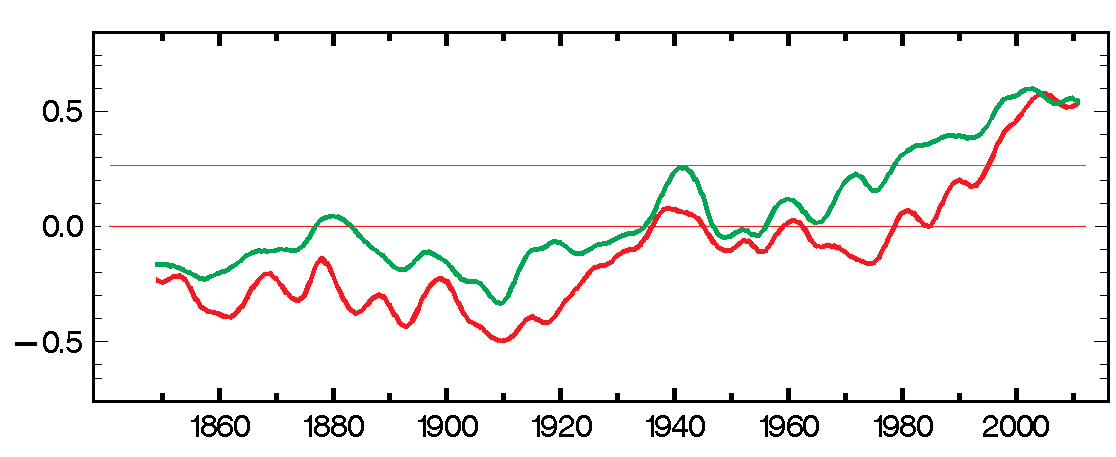
Any model for global warming has to explain the following figures, which show significantly more warming in the northern hemisphere than the southern hemisphere:

 (Bottom figure from http://nsidc.org/sotc/sea_ice.html)

One obvious difference between the northern hemisphere and the southern hemisphere is that there is a much larger fraction of ocean in the southern hemisphere than the northern hemisphere, and the ocean surely acts to moderate the air temperature. Whatever mechanism is heating the atmosphere, this heat may be being transferred to the ocean at an appreciable rate, despite the very slow mixing between surface water and deep water. 

Let’s do a rough estimation of this thermal buffering capacity using Google and our mad arithmetic skillz. If we suddenly spiked the temperature of the atmosphere by 10 degrees, how much would this increase the temperature of the deep ocean, assuming all that heat was transferred across?

8.50 km = height of atmosphere if it were all at 1 atm pressure
3.80 km = average depth of ocean

So volume of atmosphere : volume of ocean (assuming ocean covers 70% of Earth)
8.50 : 2.66

90% of the volume of the ocean is below the thermocline and will have at temperature between 0 and 3, saith the interwebz. Let’s assume at equilibrium we have just heated up this cold water, and the air and surface water have returned to the same temperatures they are at now.

So volume of hot atmosphere : volume of cold ocean
8.50 : 2.40

Volumetric heat capacity of dry air: 1.3 J.K-1.dm-3
Volumetric heat capacity of water: 4180 J.K-1.dm-3


So if the heat change in the air is
10 K x 8.50 V x 1.3 J.K-1.dm-3 = 110.5 J.V.dm-3

Then the ocean will increase by a temperature T, where
T K x 2.40 V x 4180 J.K-1.dm-3 = 110.5 J.V.dm-3

T = 110.5/(10042) K

My mad mental arithmetic skillz have deserted me, but instead of opening another window and doing it in Excel I will round it off to 100/10,000 K – near enough to 0.01 degrees. So the net effect of whatever cockamamie stuff we have done to increase the temperature of the atmosphere ten degrees has been to increase the temperature of the deep ocean from 1.5±1.5 C to 1.51±1.5 C.

Just something to think about.

But, maybe the difference between hemispheres is not due to the effectiveness of heat transfer to this ubersink. Since there is another obvious difference between the hemispheres. About 90% of the human population – and all that other stuff associated with humans – is in the northern hemisphere.
Most of the things we do to the atmosphere change what is going on near the surface, where there are big fluxes for all sorts of other reasons.  But we have made big changes to parts of the atmosphere where not much usually happens. Pumping carbon dioxide and water vapour into the upper atmosphere with our big jet planes, f’rinstance.


I’ve stolen this picture of a place in the northern hemisphere where there is a lot of air traffic. It often looks like this, though not quite as bad, where I live, which is a relatively air-traffic-crowded part of the southern hemisphere. The picture is at sunset because, while I don’t know much about clouds at all, it is obvious from standing around under them that they have a cooling effect during the day and a warming effect at night. And the Cloudspotter’s Guide by Gavin Pretor-Pinney, which I can recommend without reservation, assures me that the warming effect wins.

Just another thing to think about.

****

September 13th:

Of course, if you pick a different zero point, the two curves don't look all that different:

So probably there is nothing in it after all.

****
September 10th, 2013:

The sea-ice graph looks even better now, a few years on:

Sunday, May 29, 2011

It's a small world after all

My uncle Chuck has already hand-tooled instruments that have ended up in orbit around Titan. Now, he is at the forefront of mankind's asteroid-molesting efforts!

Wednesday, October 13, 2010

ZOMG CHEM 400

A little while ago I put together a presentation which gathers/scatters some of my thoughts on teaching chemistry in the 21st century for a learning and teaching symposium, which my colleague Dr Erica Smith very kindly presented for me while I was on long-service leave.

If you are at all interested, you can go here for a link to the first draft.

Erica tells me it went very well, though there was an interruption from the audience when I referred to non-scientists as 'muggles'; one gentleman apparently took exception to being called a muggle. Though I still think this is a perfectly valid characterisation - scientists are (1) the people who understand what is really going on, and (2) those who have the power to influence their environment in a meaningful way - I have removed it in the second draft. Muggles cannot help being muggles, after all, whereas it is open to everyone to learn to think in a scientific way.

***

September 16th 2011:

I thought I would just add the slide for the Conclusion in the powerpoint presentation of this and the accompanying text I sent to Erica...


"Chris put this line of untranslated Greek in on purpose and not (just) to show off.
Until recently, this was part of the common body of knowledge expected of an educated person in our civilisation: educated people would know a little bit of Greek and recognise this as a saying of the philosopher Heraclitus.


Now, anyone who sees it, whether they are educated or not, can look it up on Wikipedia. Chris doesn’t have to tell you what it means. It is pathetically easy for you to look it up so if you have the will to know you can go and do it.


(NB: If anyone asks about the years 1900-2000, you can make derisory comments about the ‘Age of Stupid’ … that was what I was going to do.)"